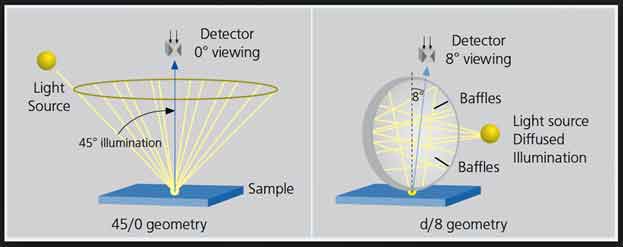
A spectrophotometer measures the actual wavelengths of light, the ‘Spectral composition’, and provides the most accurate approach of measuring colour. Wherever there is a requirement for high level colour control and colour analysis you will find that a type of spectrophotometer is in use.
Dependable and reliable colour measurement can be affected and influenced by a number of factors, such as, instrument type, instrument settings, backing, optical brightening agents, calibration, environmental conditions and more…
Some of the above can be controlled by software so you will need to check and re-check your configuration. Incorrect settings will directly affect the software you use for collecting, comparing and reporting your colour measurements.
Instrument Type
Spectrophotometers basically come in three types of geometry, 0/45 or 45/0, Sphere and Multi- Angle.
For ‘print’ colour measurement we would be using a 0/45 or 45/0 instrument, which means the light source and measurement are fixed at one of the two aforementioned angles.
Sphere and Multi-Angle instruments are mainly used for ‘industrial’ colour measurement, plastics, architectural coatings, metallic paint, etc.…
If you are comparing and sharing measurements then you should be using the same geometry and instrument type/model, etc.
Settings
Spectrophotometer settings have a direct effect on the final colour measurement values reported. Keep the same settings for consistent measurements and document your settings.
Documented settings might look like:
- 0/45 Geometry (Instrument Geometry)
- D50/2 (Illuminant and Obsever)
- M0 (Measurement mode – M0, M1, M2 or M3)
- 3mm aperture (Measurement aperture size)
- Black Backing (Backing can be white or black)
- dE2000 (Colour difference formula – dE76, dE94, dE2000, dE CMC)
- Absolute White Calibration – Calibration on white reference or substrate?
Papers or Substrates with Optical Brightening Agents (OBA’s) or FWA’s (fluorescent whitening agents)
Much of the paper produced today contains an amount of OBA’s. This chemical compound absorbs light in the UV region which then makes it appearance to our eyes in the blue region of the visible spectrum.
i.e. Paper with OBA’s looks brighter and ‘whiter’ but is actually ‘bluish’ and this is evidenced by spectral measurement and the subsequent ‘lower’ b* value. Fine Art and some special cotton-based inkjet photo papers usually contain no OBA’s and therefore appear more ‘yellowish’ than ‘white’.
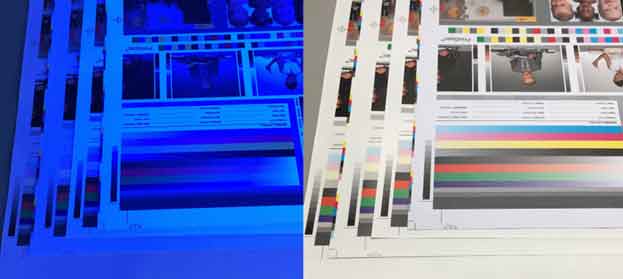
– You should use M1 or M2 for papers with OBA’s.
The image on the left is with UV light. The top printed sheet contains a high amount of OBA’s, as can be seen by the way it is ‘fluorescing’.
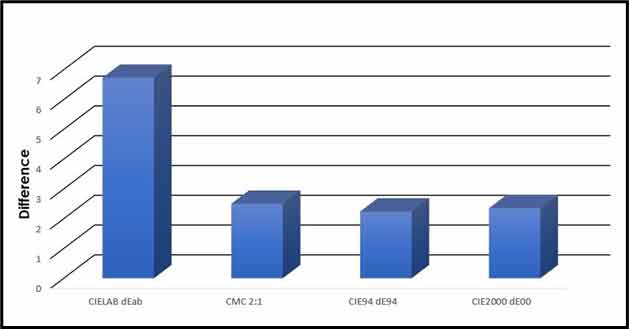
The colour difference between two solid Yellows, using different dE formulas…
Calibration
Spectrophotometer calibration on the absolute white standard is often underestimated in importance.
Before every series of measurements, a calibration should be carried out. After calibration, most devices, are stable for a long term, but we would always recommend performing calibration before starting a new series of measurements to ensure the device is working properly.
And, very important:
- Make sure the calibration plaque (white tile) is clean
- Make sure the plaque is not damaged or marked
- Use the plaque ‘matched’ to the device (same serial number)
If the plaque is not clean or marked it will introduce incorrect measurements or errors. The plaque serves as a reference, so the device then knows what ‘white’ actually is. Using a plaque from another device may allow the device to ‘calibrate’, but this will still introduce measurement errors…
Certification
Is the instrument certification up to date? Handheld and bench top spectrophotometers are precision instruments, manufactured to tight tolerances. Proper use, care and maintenance of your device will provide with you long term stable results, but they can change or drift over time and even become damaged in way that is not obvious to us.
Instruments should be periodically checked and re-certified by the manufacturer to ensure operation within specification. Some manufacturers recommend re-certification every 24 months, others every 12 months.
Setting up an in-house validation procedure for your instrument(s) is also beneficial as it allows you to track instrument performance over time, and can alert you to instrument problems and ‘drift’…
Environmental considerations
Spectrophotometers are often used in varied and diverse environments – Office conditions, production areas, laboratory or quality departments, next to or on manufacturing equipment, etc. But they are still precision instruments and do not like extremes in temperatures or being dropped. Dust, dirt and other contaminants are enemies of spectrophotometers – dirt or dust on the optics can really affect the measurements. Take care to ensure your instruments optics are kept clean – dry compressed air is good to clean dust/dirt from external optics, external glass and the casing.
Spectrophotometers are often used in varied and diverse environments – Office conditions, production areas, laboratory or quality departments, next to or on manufacturing equipment, etc. But they are still precision instruments and do not like extremes in temperatures or being dropped. Dust, dirt and other contaminants are enemies of spectrophotometers – dirt or dust on the optics can really affect the measurements. Take care to ensure your instruments optics are kept clean – dry compressed air is good to clean dust/dirt from external optics, external glass and the casing.
To get dependable measurement you should pay close attention to;
- Measurement settings – including backing
- Instrument calibration procedures – including checking the white tile
- Certification, is it up to date? And in-house validation procedure
- Where is the instrument used? – consistent room temperature, dust and dirt
For more information about the benefits of using a Colour Spectrophotometer training and the Printer Colour Calibration please contact us via our contact form